Worked Example: Palmer Penguins
Palmer Penguins
To demonstrate the typical use-case of the Bayesian Mixture of Experts (bmoe) we make use of the Palmer Penguins dataset. For model validation purposes, we split our inputs into training and testing datasets using random sampling, stratified by species.
data_split <- initial_split(penguins, prop = 0.9, strata = "species")Suppose we are interested in fitting a model to explain bill_length_mm using flipper_length_mm and assume a linear relationship. We could improve this model by assuming the relationship will vary by penguin species.
This can be done in a single linear mixed effects model with lme4 or brms. Alternatively, we could fit three separate models as shown below.
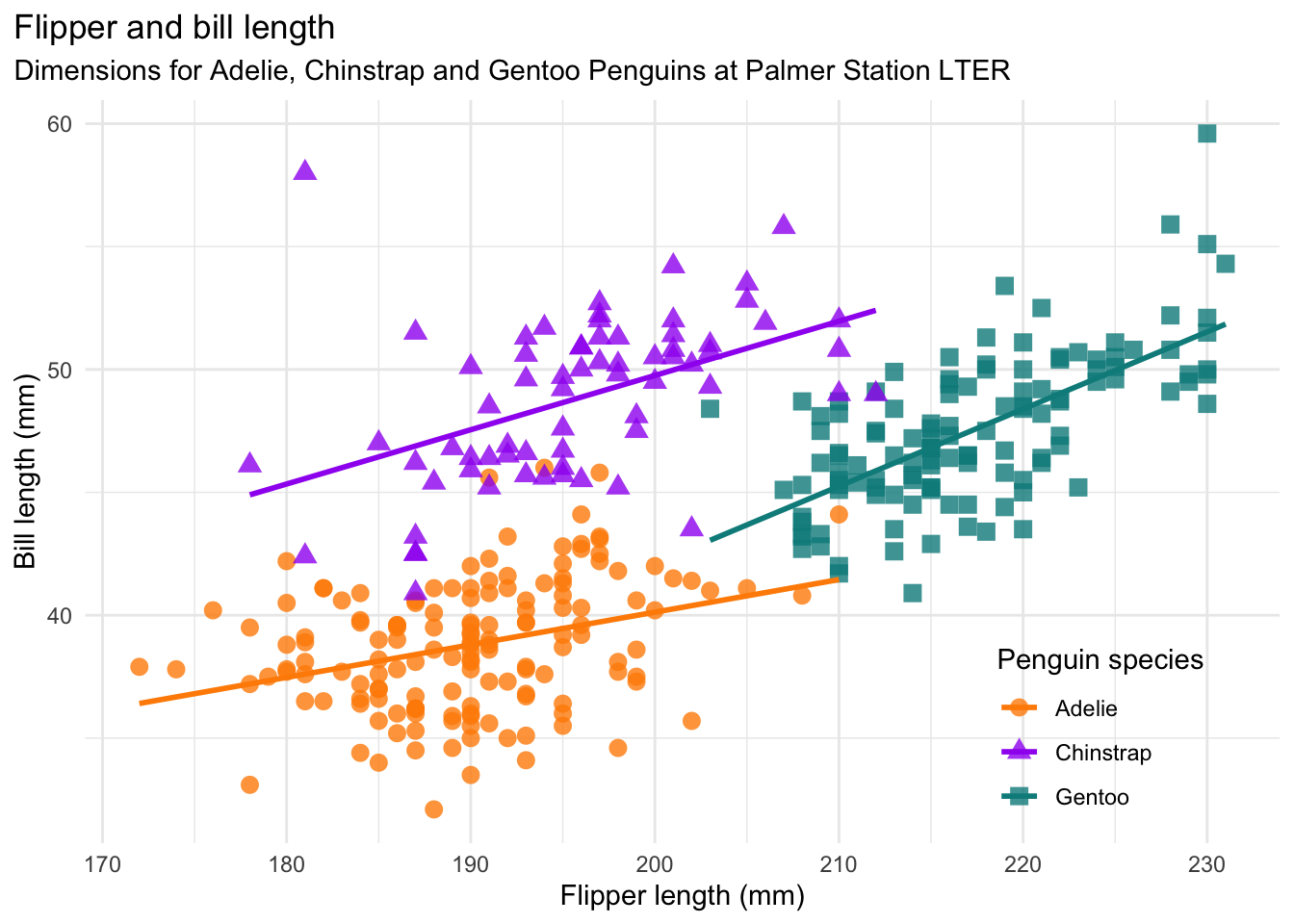
For the Bayesian Mixture of Experts model, we assume that the underlying component allocations (species) is not observed. While assigning meaning to each component helps with interpretation, it is not necessary for the model to be fit.
Therefore, the bmoe engine will simultaneously classify each observation into one of components, where is assumed known, and fit a mixture of regressions.
model_fit <-
  bmoe::bmoe(
    bill_length_mm ~ flipper_length_mm,
    prior = bmoe::bmoe_prior(k = 3),
    data = rsample::training(data_split)
  )
Compiling model graph
Declaring variables
Resolving undeclared variables
Allocating nodes
Graph information:
Observed stochastic nodes: 306
Unobserved stochastic nodes: 319
Total graph size: 3972
Initializing modelTODO
Both fits seem similar, need to improve classification accuracy
validation_data <-
  dplyr::mutate(
    rsample::testing(data_split),
    # TODO: Need to reduce the amount of work to get point estimates
    .pred_response =
      stats::predict(
        model_fit,
        new_data = rsample::testing(data_split),
        type = "response"
      ) |>
      purrr::pluck(".pred_bill_length_mm") |>
      purrr::map_dbl(\(.x) mean(.x$mean)),

    .pred_lm =
      stats::predict(
        lm_fit,
        newdata = rsample::testing(data_split)
      ),

    .after = "bill_length_mm"
  )